




18 May 2026
Walk into almost any boardroom in the Dutch high-tech ecosystem right now and “China plus one” will come up before the coffee gets cold. It’s a useful catchphrase: keep producing in China, but build a credible alternative somewhere else. What it doesn’t capture is the bigger shift happening underneath. Companies asking these questions aren’t just hedging against one country. They’re rebuilding their supply chains for a world where geopolitics, regulation, and customer demand all push in different directions at once.
That’s the conversation worth having.
What “China plus one” really means
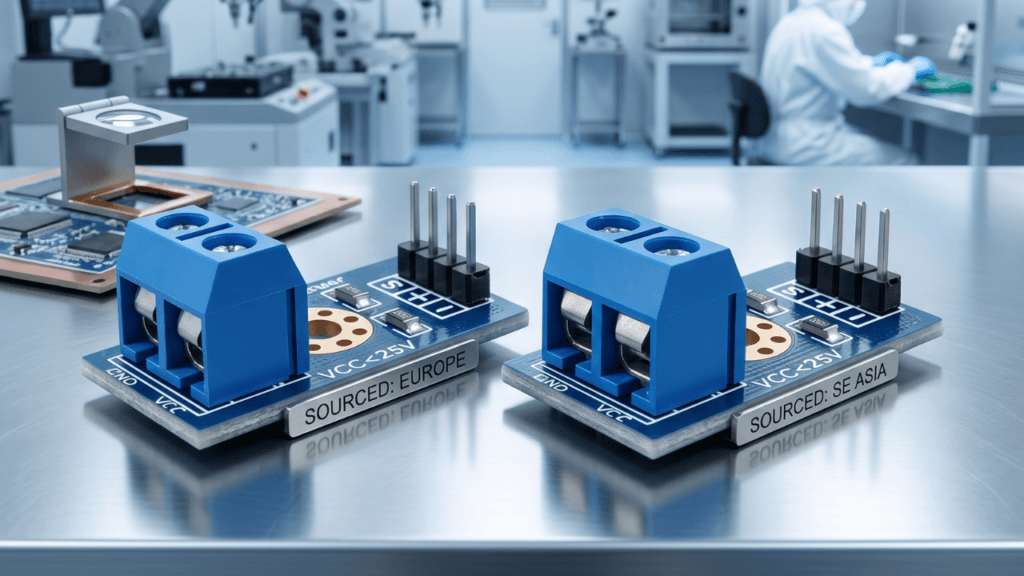
The term is straightforward. If your production sits in China, build a parallel capability somewhere else, whether that’s Malaysia, Singapore, Taiwan, or somewhere in Europe. It sits alongside two related supply chain strategies you’ll hear in the same boardroom conversations: nearshoring, which moves production closer to home (think Eastern Europe, Mexico, or southern EU), and reshoring, which brings it back to the home country entirely. All three strategies are different answers to the same underlying question: how much exposure to a single region can you afford. The point is optionality. If something disrupts your supply flow from China, an export restriction, a tariff change, a customer policy, a sudden tightening of rules, you have somewhere else to land.
What’s less obvious is that the pressure now comes from both directions.
On one side, Western OEMs are being asked by their own customers to demonstrate that they can keep delivering regardless of what happens in China. A US chipmaker tells an EU equipment supplier they need supply continuity guarantees. That supplier, in turn, tells its own tail-spend suppliers the same thing. The signal travels all the way down the chain.
On the other side, China is pushing in the opposite direction. Beijing has been transparent about its goal: build a self-sufficient semiconductor industry, and use procurement policy to accelerate it. Made in China 2025 targeted 70% domestic localization by the end of last year, with the actual figure landing closer to 30% (CSIS, 2025). In 2024, China’s Ministry of Industry and Information Technology instructed telecom operators to remove all foreign semiconductors from their networks by 2027 (Reuters, 2024). Reports from late last year suggest China is moving toward formal local content requirements for the semiconductor sector, with companies producing in China expected to source roughly 50% of their equipment locally (Logfret, 2024). According to CSIS, China has channeled around $150 billion in public funding into the sector, dwarfing the US CHIPS Act (CSIS, 2025).
So when I talk to procurement leaders about “China plus one,” I’m talking about two simultaneous shifts. Customers are demanding alternatives outside China, and China is simultaneously demanding more inside China. Both pressures lead to the same conclusion. You need a supply chain that can flex.
Different companies, different problems
Not every company experiences this the same way. A semiconductor equipment maker with significant business on both sides of the US-China divide has to navigate the most politically charged version of the question, balancing customer expectations in two markets that increasingly point in opposite directions. Another player in the same industry, but with a customer base weighted more heavily toward the US, frames the problem very differently. Their concern is less about needing a “plus one” and more about ensuring that critical components don’t originate in China at all. Same industry, very different exposures, very different procurement priorities.
The same logic plays out further down the chain. Many of the Dutch suppliers exploring or expanding into Malaysia, Singapore, or Vietnam are there not entirely by choice (NRC, 2025). Their existing customers are asking, sometimes informally, sometimes explicitly, for a presence in Southeast Asia.
Various regions in the world are trying to establish themselves in the global ecosystem of semicon. Smaller and larger initiatives are often directed to build or strengthen a local ecosystem. The complexity of the supply chains will grow. Not in the least when also the EU in the future will be demanding more and more local sourcing to support the EU Chips act 2.0.
China plus one isn’t unique to the semiconductor industry. The same dynamic is showing up in defense, where European programs increasingly require that funding circulate within European supply chains. Different drivers, same underlying logic: source locally, reduce exposure, keep the value at home.
Where the real risk hides: the tail
For most of our partners, the strategic core of their supply chain, the IP-heavy components and deeply engineered modules, isn’t easily moved. Those relationships are decades old and built on shared development. That’s not where the China plus one question really bites.
The risk often sits in the tail. Generic components, legacy items, and parts that have been quietly sourced from a single region for years. These rarely show up on a procurement dashboard. They don’t justify a strategic review on their own. But if they suddenly become unavailable, machines stop running, and there’s no easy alternative engineered in.
Add the legacy supplier problem on top of that, fielded equipment that still depends on parts from suppliers nobody has revisited in a decade, and you have a meaningful exposure that’s almost invisible until it isn’t. Re-engineering a working machine to qualify a new supplier isn’t a quick fix. It’s months of work, sometimes longer, and in a real disruption you don’t have months.
Think in scenarios, not in headlines
My honest advice to procurement managers isn’t “decouple from China.” A serious supply chain strategy is more practical than that.
Map your categories. Decide which parts of the supply chain you’ll always keep in your own hands, the truly strategic ones, and which sit in the tail. For the tail, ask a different set of questions. If China closed its export doors tomorrow, would your production keep running? If a customer asked you to demonstrate a non-China alternative within ninety days, could you? If a legacy supplier went silent, who’s your backup?
If the answers are “I don’t know” or “probably not,” that’s not a problem to solve during a crisis. That’s a problem to solve now, when you still have time and options.
Where MAG45 helps
This is the part of the supply chain we live in every day. We deliver integrated supply solutions across multiple regions, China included, but also South East Asia, the US, and across Europe, with the same systems, the same quality standards, and the same point of contact for our partners. When a partner’s situation changes, scaling up in Asia, pulling back to a Western footprint, qualifying a second source, the network is already in place.
China plus one is a useful supply strategy. So are reshoring and nearshoring. But labels aren’t a supply chain strategy on their own. The goal is resilience, the ability to keep delivering when the assumptions you built your supply chain on stop holding. The companies that come out of the next few years in good shape will be the ones that started building optionality before they were forced to.
For a deeper look at how this localization shift is reshaping global supply chains, read China for China, Europe for Europe, US for US by our CEO Bauke Zeinstra.

Mark Telgenkamp
Mark Telgenkamp is Business Development Manager at MAG45. With a strong background in both finance and sales, he helps high-tech, medtech and industrial manufacturers turn tail supply complexity into a strategic advantage. Mark is known for building sustainable partnerships that drive measurable value combining analytical thinking with a collaborative, people-first approach.