





3 February 2026
Monday morning, 07:32. An engineer walks into the storeroom looking for an M12 bolt. It’s not there. It’s not in the system either; or rather, the system says there are twelve in stock, but the shelf is empty. The supplier’s lead time? Six weeks. The production deadline? Friday.
If this sounds familiar, you’re not alone. And more importantly: it’s not your team’s fault.
Why tail supply keeps falling through the cracks
Tail supply – the thousands of low-value parts that keep production running – is fundamentally difficult to manage. Not because the parts are complicated, but because they’re easy to ignore. They don’t show up in strategic reviews. They don’t have dedicated category managers. And when something goes wrong, it’s usually too late.
The result is a pattern that plays out in manufacturing environments around the world: engineers searching for parts, production lines waiting, and inventory that nobody fully trusts.
Here’s what we’ve learned from working with machine builders for over 75 years: the small parts cause the biggest disruptions. Not because they’re complex – but because nobody owns them.
Three signs your tail supply needs attention
These are the silent productivity killers we see in almost every production environment we enter.
1. Found on the workshop floor

Critical parts that should be in storage end up scattered across workstations, toolboxes, and personal drawers. Without a system, there’s no visibility—and no accountability. The parts exist somewhere, just never where you need them.
2. The waiting game

Production stops while purchasing chases a €12 part across three time zones. Emails go back and forth. Suppliers are slow to respond. And meanwhile, the cost of the delay quietly climbs to 100x the value of the part itself.
3. The “Emma” problem
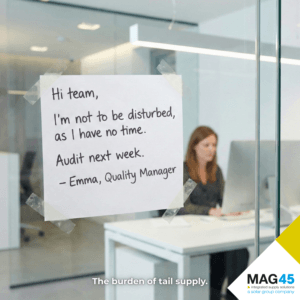
Every team has one person who just knows where everything is. They can find the latest CoC, know which supplier is still missing an RoHS declaration, and have a sixth sense for when documentation might be outdated. But what happens when Emma is on holiday? Or when she leaves?
These are just three examples; but we could easily name ten more. The pattern is always the same: small issues that quietly drain time, money, and energy until someone finally decides to fix the root cause.
The real cost
The impact of unmanaged tail supply is rarely visible on a single invoice. Instead, it shows up in hidden costs, resulting in higher Total Cost of Ownership (TCO) over time:
- Expedited shipping fees
- Duplicate orders from different departments
- Engineer overtime spent searching, not building
- Production delays and missed deadlines
- Overstocked shelves of the wrong parts
- Understocked shelves of the critical ones
For many manufacturers, these hidden costs add up to €200,000 or more per year, without anyone noticing until they start looking.
Why does this keep happening?
The short answer: tail supply falls between the cracks.
Procurement teams are focused on strategic spend; the big-ticket items that move the needle. Operations teams are focused on output. Engineers are focused on solving technical problems, not chasing screws. And so tail supply ends up being managed reactively, by whoever happens to notice the problem first. There’s no single owner. No dedicated process. No structural solution.
That’s why the same problems keep recurring. Different day, same story.
What it takes to fix it
Solving tail supply chaos isn’t about working harder; it’s about changing the structure. That means:
Consolidating suppliers – Instead of managing hundreds of relationships, work with a single partner who takes responsibility for the full tail.
Creating real visibility – Replace spreadsheets and tribal knowledge with real-time data on stock levels, consumption, and replenishment.
Proactive replenishment – Move from reactive ordering to a system where parts arrive before you need them, based on actual usage patterns.
Assigning clear ownership – Someone needs to own tail supply as a discipline, not as a side task.
For high-tech, med-tech, and industrial manufacturers, this often means partnering with a specialist who can integrate sourcing, inventory, and process management into one streamlined service.
Conclusion
Tail supply chaos isn’t a people problem; it’s a structural one. The engineers aren’t failing. The procurement team isn’t lazy. The system simply isn’t designed to handle thousands of low-value parts with the attention they require.
The good news? It’s fixable. With the right structure, the right visibility, and the right ownership, the chaos disappears. Engineers go back to engineering. Production runs on time. And Monday mornings get a lot less stressful.
Get in touch
Curious if there are ways to reduce your Total Cost of Ownership? Or do you have any other questions regarding our services?
Get in touch with Mark, one of our Integrated Supply specialists.

Mark Telgenkamp
Mark Telgenkamp is Business Development Manager at MAG45. With a strong background in both finance and sales, he helps high-tech, medtech and industrial manufacturers turn tail supply complexity into a strategic advantage. Mark is known for building sustainable partnerships that drive measurable value combining analytical thinking with a collaborative, people-first approach.