


“These items aren’t in the bill of materials. The client knows they need a specific drill to produce an implant, but not whether they need ten or twenty per hundred products. That was never registered.”
— Dirk van den Hengel, CCO at MAG45
A global medical technology manufacturer produces orthopedic implants at multiple sites across Europe and Asia. Starting from raw titanium bars, each implant goes through a series of production steps: milling, drilling, grinding, surface treatment, and finishing. Every one of those steps requires consumable materials. Cutting tools to shape the titanium. Grinding belts to smooth the surfaces. Chemicals for material treatment. Protective equipment for the operators.
These production consumables are essential for keeping the line running, but they rarely receive the same procurement attention as the components that end up in the finished product. They don’t appear on the bill of materials. An engineer specifies which drill bit is needed to machine a particular implant, but often nobody tracks how many are used per production run, how quickly they wear out, or when they need replacing.
That makes demand hard to predict, waste hard to spot, and costs hard to control.
The challenge
For manufacturers in regulated industries like medical technology, production consumables create a particular set of supply chain challenges. They still need to meet quality and compliance standards. Supplier documentation must be maintained. Traceability requirements apply. Yet because these items fall outside the bill of materials, they typically receive far less structured procurement oversight.
For this client it resulted in:
- Limited visibility on consumption patterns. The factories produced dozens of different implant types across different machines, each requiring specific tooling. But there was no systematic record of how many consumables were used per product or production run.
- Limited forecasting capability. Procurement planned consumable orders based on historical usage rather than upcoming production schedules. When production plans changed, consumable orders didn’t adjust, leading to shortages or overstocking.
- Excess safety stock across sites to compensate for unpredictability, tying up capital and warehouse space.
- A fragmented supplier landscape with no consolidated overview. Each site managed its own vendors, pricing, and processes, with no cross-site benchmarking or standardization.
- Manual, time-consuming replenishment that consumed procurement time on low-value ordering activities.
This is a common pattern among manufacturers that have professionalized the procurement of their strategic components but haven’t yet extended that discipline to the consumables that support production.
The results at a glance
- Hundreds of suppliers consolidated, thousands of unique items under management.
- Year-over-year TCO savings, growing as the partnership program matures.
- Fewer stock-outs through production-linked forecasting, while simultaneously reducing stock levels.
- Dedicated on-site MAG45 teams handling day-to-day operations, freeing client procurement for strategic work.
- 10+ year partnership, expanded from 2 sites to multiple locations across Europe and Asia.
The solution: integrated supply for production consumables
MAG45 took full ownership of the client’s production consumables supply chain. Rather than simply consolidating suppliers or negotiating lower prices, MAG45 extended its integrated supply approach to cover the entire consumables lifecycle: from automated replenishment on the production floor, through continuous optimization, to centralized data and reporting.
Phase 1: making replenishment invisible
The starting point was removing the burden of ordering from the production floor entirely.
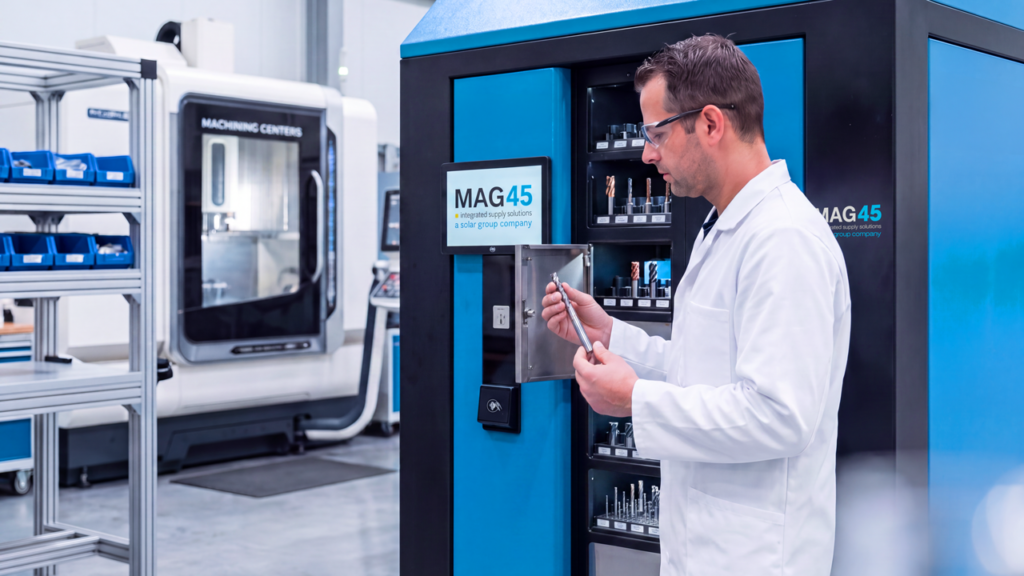
For high-value consumables such as cutting tools, MAG45 installed automated dispensing systems directly in the production environment. Operators simply take what they need. The system registers every withdrawal, and MAG45 replenishes stock automatically, typically overnight. No purchase order, no approval workflow, no waiting time.
For frequently used, lower-value items like grinding materials, protective equipment, and general production supplies, MAG45 implemented kanban-based systems. When a bin is empty, it triggers a replenishment signal. MAG45 handles the rest. For non-standard or one-off items, a straightforward request-and-quote flow ensures even unusual requirements are handled quickly.
All of this consolidates into a single invoice, replacing what used to be hundreds of individual purchase orders across multiple suppliers.
Phase 2: the partnership program
What sets this approach apart from basic supply management is what happens once the foundation is in place. A dedicated MAG45 team works with the client on an ongoing partnership program aimed at reducing costs and improving performance over time. This is where the compounding value sits.
Reconditioning. Some cutting tools cost over €1,000 per item. When a tool reaches the end of its useful life, it doesn’t have to be discarded. MAG45 collects worn tools and arranges for the original manufacturer to remove and reapply the coating, restoring the tool to working condition. Reconditioning costs roughly 20% of the price of a new tool. Across multiple sites and thousands of tools per year, the savings are substantial, and they recur.
Forecasting. MAG45 developed a method to link consumable demand directly to the client’s production planning. Starting from the end-product schedule, the team maps which tools and materials each product requires, measures how long each tool lasts under normal conditions, and calculates the exact quantities needed. This replaces the old approach of ordering based on last month’s usage. Fewer stock-outs, less overstock, and the ability to adjust consumable supply before production plans change rather than after.
Supplier engagement. MAG45 organizes structured sessions where multiple tool manufacturers are briefed on a specific production challenge and asked to propose optimized solutions. At one site, six suppliers competed to improve a single production process. The result: better tooling technology, reduced process steps, significant annual hard savings, and a second source of supply that reduced dependency risk.
Standardization. By harmonizing consumable assortments across sites, the client achieves economies of scale that no single location could realize on its own.
Data, reporting, and control
Throughout the partnership, MAG45 maintains a centralized database covering all consumables under management: specifications, pricing, lead times, supplier performance, and consumption patterns. This gives the client a consolidated view that never existed before. Instead of fragmented data spread across sites and systems, there is one place to see what is being used, what it costs, and where the next improvement opportunity lies.
What’s next
The consumables landscape is not static. Recent supply restrictions on tungsten, a key raw material in cutting tools, have driven up prices across the industry. That makes structured production consumables management more valuable than ever: the more expensive the inputs, the more there is to gain from extending tool life, reducing waste, and optimizing usage.
For this client, the next phase of the partnership includes consolidating personal protective equipment across all sites – a category with significant standardization potential – as well as expanding the forecasting approach to additional production lines and locations.
Tungsten prices are rising. The sooner you gain control over your consumables, the more you save. Tell us about your production consumables and we’ll show you where your savings sit. Ask your question

Dirk van den Hengel
Dirk van den Hengel is Chief Commercial Officer at MAG45. Dirk is a Supply Chain Management professional with a strong track record in business consultancy and project management. He co-developed MAG45’s international project management department and helped create the company’s value proposition.