




What the Iran conflict reveals about tail supply resilience in manufacturing
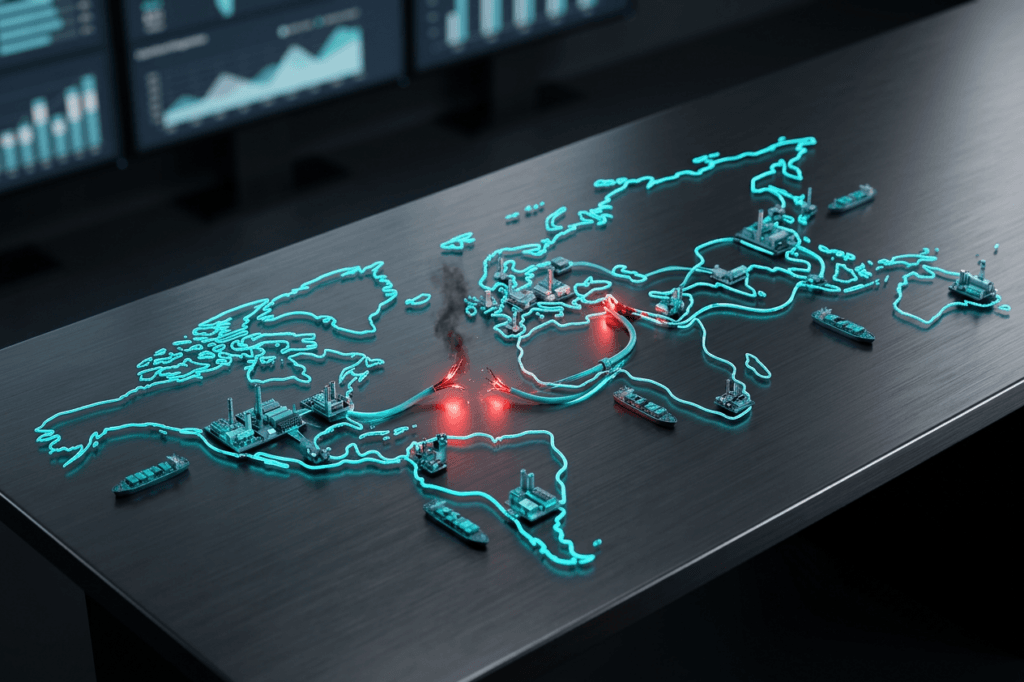
On February 28, 2026, U.S. and Israeli forces launched strikes on Iran. Within days, shipping traffic through the Strait of Hormuz had dropped sharply, with tanker movement falling dramatically as vessels waited outside the strait due to security threats. That narrow waterway carries roughly one-third of all seaborne crude oil and large volumes of liquefied natural gas (source). The ripple effects hit energy markets, freight costs, and manufacturing lead times almost immediately.
At the moment I’m writing this, a ceasefire is in place. However, peace talks in Pakistan have just collapsed after 21 hours of negotiations, and as of this week, the U.S. Navy has announced a blockade of Iranian ports in the Strait of Hormuz. The situation remains deeply uncertain.
Before anything else: this is a human crisis
People are losing their lives. Families are being displaced. That context matters, and it should shape how we talk about the business implications, not as an afterthought, but as the starting point.
With that said, those of us responsible for production continuity face an unavoidable question: What does this disruption mean for our operations, and are our supply chains resilient enough to absorb it?
A familiar pattern, at greater scale
The Iran conflict is disruptive, but it is one in a long line of increasingly pervasive issues challenging global supply chains, including pandemic-related shutdowns, weather events, geopolitical tensions, and inflation (source). What makes this moment different is the scale of the chokepoint. The Strait of Hormuz carries roughly one-fifth of the world’s oil supply. Any disruption in that corridor immediately reverberates through global manufacturing and transport systems (source).
Air freight costs spiked significantly in the days following the escalation, while global air cargo capacity dropped 18% from the previous week (source). For manufacturers in high-tech, medtech, and industrial equipment, strategic components get the attention they deserve: dedicated managers, approved vendor lists, quarterly risk reviews. It’s the tail where things get quiet, thousands of low-value parts, present in every machine, tracked by no one.
Not choosing resilience means choosing reactiveness
The manufacturers who are navigating this period most effectively share a few characteristics. They have consolidated their tail supply to a smaller number of integrated partners. They hold strategic buffer stock in critical categories. They have real-time visibility into inventory levels and supplier performance. And they made these decisions before they needed them.
Consolidation in tail supply is not primarily about cost reduction, though that follows. It is about response capability. When one integrated partner manages your full tail supply, monitors supplier risk, holds aligned inventory, and understands your production schedule, a disruption becomes a managed variable rather than a crisis.
This is why we talk about integrated tail supply as a strategic lever, not an operational convenience. The value is not visible when everything runs smoothly, it becomes visible when it doesn’t.
Three questions worth asking now
If your team hasn’t already reviewed your tail supply exposure in light of the current conflict, these are the questions that matter:
- Do you know which components in your tail spend are sourced through Middle East logistics corridors or depend on energy-price-sensitive production processes?
- Do you have buffer stock of high-risk, long-lead-time items in your electrical and mechanical tail categories?
- Does your supply chain partner have the visibility and mandate to respond proactively, or are they waiting for you to raise the alarm?
The answers will tell you more about your actual resilience than any risk framework document.
The bigger picture
This is the fourth significant supply chain shock in five years. Each one has exposed the same structural vulnerability: supply chains optimized for efficiency under stable conditions, with limited capacity to absorb instability.
The Iran conflict will eventually resolve. Hopefully sooner rather than later. But the next disruption is already forming somewhere else. Manufacturers that treat each crisis as a one-time event will keep reacting. The ones that treat it as a signal will rebuild differently.
Want to assess your tail supply resilience?
Resilience in tail supply is not a complex transformation. It starts with visibility, and a partner who takes ownership of the problem. The moment to make that decision is always before you need it.

Bauke Zeinstra
Bauke Zeinstra is Chief Executive Officer at MAG45 and Senior Vice President at Solar. He joined the company in 2014, having previously worked in several prominent positions in International Procurement and Industrial Sales. Bauke holds a Bachelor’s degree in Business Administration and a Master’s in Political Science and Government.