How Stryker Cestas reduces inventory without risking downtime
At Stryker’s Cestas site, finding the right balance between material availability and inventory cost had long been a challenge. It wasn’t just about avoiding downtime – overstock and excess working capital also needed to be addressed. As part of our integrated business model built on Kaizen and continuous improvement, we introduced a new demand forecasting approach. It’s a clear example of how we turn small, smart changes into lasting impact: the site now proactively plans its tooling needs, purchases more strategically, and lowers stock levels—all while improving control, visibility, and supply reliability.
The situation before the new demand forecasting approach
Before the introduction of MAG45’s new demand forecasting model, Stryker Cestas did not take into account future information in the prediction of indirect material requirements. The team relied on historical consumption data from the past year, assuming future demand would follow the same trend. This method led to delays, hesitance in decision-making, and manual adjustments based on incomplete or outdated insights.
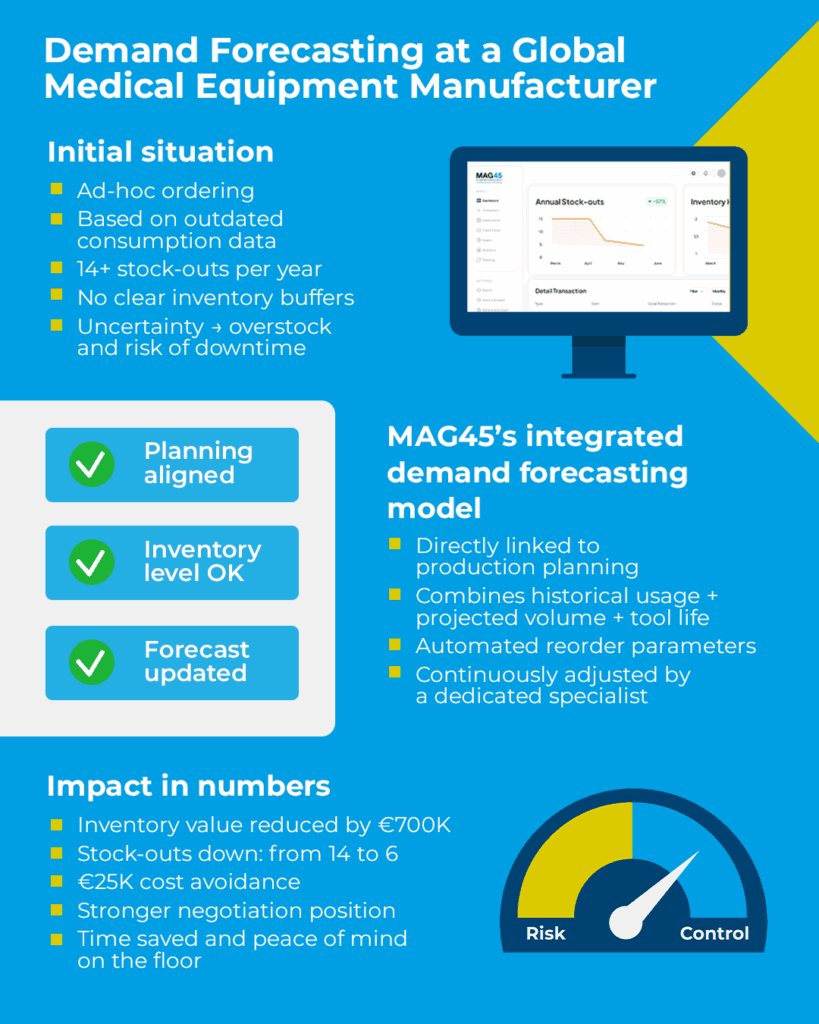
Changes in production planning were difficult to anticipate, and every deviation triggered time-consuming discussions and validation steps. The process was not only inefficient, but also error-prone and stressful for the local teams. In 2023, this lack of predictability contributed to 14 stock-outs, which—although not all equally disruptive—posed serious risks for production continuity and required emergency actions.
The solution implemented by MAG45
To ensure tool availability without overstocking, MAG45 implemented a custom demand forecasting model at the Stryker Cestas facility. The forecasting method combines historical consumption and past production volumes to calculate the expected tool life. This data is linked directly to Stryker’s production forecast to calculate tooling needs per item group. Once the reorder levels are set, orders are triggered automatically. This enables restocking just in time—without excess.
While the model was initially developed for indirect materials such as cutting and milling tools, its structure and logic can be applied to any item category where demand follows production planning—making it scalable across a wide range of materials and sites.
“We translate Stryker’s planned production volume into our own items: how much can be produced with one of our tools, and therefore, how many tools are needed over a specific period.”
— Esmee Bos, Logistics Engineer at MAG45
Operational as well as tactical gains
The model operates on both tactical and operational levels. Tactically, it ensures the right inventory buffers are maintained. Operationally, it allows real-time adjustments when forecasts shift. Weekly updates to the production plan are continuously reviewed by a dedicated MAG45 specialist, who fine-tunes the model as needed.
This integrated approach not only prevents stock-outs and reduces inventory—it also provides the clarity needed to make more strategic purchasing decisions. With a clear forecast, Stryker can now purchase in bulk when confident about demand, which has led to item cost savings through volume discounts. Where uncertainty once limited purchasing power, clarity now creates leverage.
“For other Stryker sites, this approach offers a tested way to gain control, reduce risk, and unlock savings. Cestas has done the heavy lifting—making it easier for others to benefit from a proven model.”
— Remco Driessens, Key Account Manager MAG45
Results and impact
Since the implementation of demand forecasting at Stryker Cestas, the improvements have been both quantifiable and strategic:
- Stock-outs reduced from 14 to 6 per year.
- At least €25,000 in cost avoidance related to production risks and emergency orders.
- Inventory value reduced by €700,000 (from €2 million to €1.3 million).
- Improved negotiation position by enabling larger, confident volume purchases.
- Less stress and manual work for the site team due to clearer insight and predictability.
These results demonstrate how demand forecasting contributes not only to supply chain performance, but also to peace of mind on the work floor.
Closing perspective
What makes this case stand out is the combination of precision and partnership. By aligning production forecasts with tool usage, Stryker Cestas can now make sharper decisions, avoid waste, and reduce complexity. While setting up such a system requires time and collaboration, the long-term benefits far outweigh the effort. As Stryker Cestas has shown, demand forecasting is not just a planning tool—it’s a strategic capability.